
The April Burnout: Why Your Stress Needs a Strategy, Not a Sledgehammer
Fitness | Nutrition | Lifestyle April 14, 2026 • 9 min read
April is a month of grand illusions. We look out the window at the budding trees and think of renewal, but then we look at our desks and see a mountain of tax documents, a social calendar that suddenly exploded after the winter thaw, and the looming pressure of "summer body" marketing.
If you feel like you’re running on a treadmill that someone else is controlling the speed of, you’re not alone. But before you head to the Studio with the intention of "punishing" yourself into a better mood with a high-intensity soul-crushing workout, we need to have a little chat.
Because sometimes, the harder you push, the further back your body retreats.
Meet Sarah: The "Do-It-All" Dilemma
To understand why, let’s look at Sarah. Sarah is 52, a powerhouse at her marketing firm, and the unofficial COO of her household. Between managing her team’s quarterly goals and navigating the emotional rollercoaster of her teenager’s high school finals, Sarah is exhausted.
She knows she feels better when she exercises, but her brain tells her that if she isn't dripping in sweat and gasping for air, it "doesn't count." Last Tuesday, after a ten-hour workday and a frustrating call with her insurance company, she dragged herself into a HIIT session. She pushed through the burpees, but halfway through, she felt... empty. Not the "good tired" of a productive workout, but a hollow, shaky fatigue. That night, she couldn't sleep, and the next morning, she felt like she’d been hit by a truck.
What Sarah didn't realize is that her body couldn't tell the difference between the "stress" of her boss and the "stress" of her workout. To her nervous system, it was all just one big alarm bell.
The Science of the "Internal Alarm": Your HPA Axis
When we talk about stress, we have to talk about the HPA Axis. This stands for the Hypothalamic-Pituitary-Adrenal Axis.
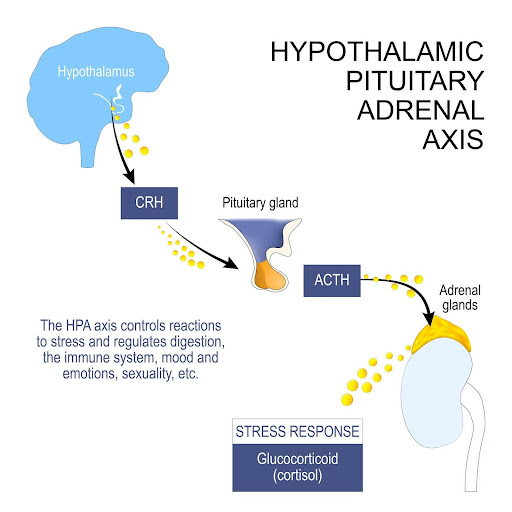
Think of it as your body’s central command center for stress. When you’re stuck in traffic or worried about a deadline, your hypothalamus sends a signal to your pituitary gland, which then tells your adrenal glands to pump out cortisol—the "stress hormone."
In short bursts, cortisol is great. It helps you wake up in the morning and gives you the focus to finish a task. But when Sarah is chronically stressed, her HPA axis is stuck in the "on" position. This leads to:
Dysregulated Blood Sugar: High cortisol tells your body to dump glucose into the bloodstream for "energy" you aren't actually using to fight a saber-toothed tiger.
The "Cortisol Pooch": Excess cortisol is highly correlated with the accumulation of visceral fat—the fat deep in your abdomen that surrounds your organs.
Muscle Breakdown: Ironically, too much stress can actually impair the muscle-building process you’re working so hard on in the gym.
Why "Going Harder" Isn't Always the Answer
When your HPA axis is already red-lining, a super-intense workout can be the straw that breaks the camel's back. High-intensity exercise is a physical stressor. Usually, our bodies adapt to that stress and get stronger. But if your "recovery bucket" is already full of work stress and family drama, there’s no room for workout stress.
This is where many people give up. They think, "If I can't go 100%, why go at all?"
We’re going to hold your hand when we say this: Showing up is the victory. The intensity is secondary.
This isn't just Studio philosophy; it's the new gold standard in sports medicine. The American College of Sports Medicine (ACSM) recently released updated guidelines that shift the focus from "how hard" to "how often." The core takeaway? The most beneficial action you can take for your long-term health is simply the act of getting to the gym.
Regardless of whether you spend your 45 minutes hitting a Personal Record on your deadlift or simply doing light mobility work and some low-intensity rowing, the physiological benefit of maintaining the routine outweighs the specific metrics of the workout itself. The ACSM emphasizes that the psychological habit of showing up creates a "positive feedback loop" that actually helps regulate the HPA axis over time.
Training for Your Current Reality
At Studio in the Heights, we don't believe in "one size fits all" fitness. We believe in "one size fits you today."
On the days when Sarah is feeling the weight of the world, a Shared Personal Training (SPT) session is actually the best place for her. Why? Because she has a coach who can look at her and say, "Sarah, you look wiped. Let's pull back the weight today, focus on your form, and get some good blood flow through those joints."
We might focus on:
Strength with Intention: Slower reps to focus on the mind-muscle connection, which helps ground the nervous system.
Mobility & Breath: Using movement to tell the body it’s safe to exit "fight or flight" mode.
Community: Just being in a room with people who know your name can lower your heart rate and boost your oxytocin (the "connection" hormone).
April Recovery: Your Action Plan
If you’re feeling the April rush, don’t cancel your session. Change your expectations. Here is how to navigate a high-stress month without burning out:
Listen to Your Biofeedback: If you woke up with a resting heart rate that's 10 beats higher than usual, or if you feel "wired but tired," tell your coach.
The 10-Minute Rule: Tell yourself you’ll go to the Studio for 10 minutes. If you still want to leave after that, you can. (Spoiler: Most people stay, and they feel 100% better for it.)
Prioritize Sleep over "Extra" Cardio: If it’s a choice between a 5:00 AM run on four hours of sleep or an extra hour of rest, take the sleep. Your cortisol will thank you.
Lean on the Community: We are more than just a gym. We are a soft landing spot for your hard days.
Real Strength is Resilience
Coach Lisa often reminds us of a client who spent an entire April just doing light mobility and basic strength work because she was going through a grueling home renovation. She felt "guilty" for not pushing harder. But when May rolled around and the stress subsided, she was shocked to find she hadn't lost an ounce of progress. In fact, because she hadn't injured herself or burned out, she was able to jump right back into her higher-intensity goals with a fresh engine.
You aren't a machine. You’re a human being. Some seasons are for sprinting; others are for steady steps. This April, give yourself permission to just be there. Whether you’re crushing weights or just moving through a lunge, you are doing the work that matters for the next 30 years of your life.
Ready to find your balance? Explore our SPT schedule, Book a Fitness Assessment or come in and take a Slow Flow yoga class and just slow down and breathe. Ask us how we can tailor your routine to your life, not the other way around.
